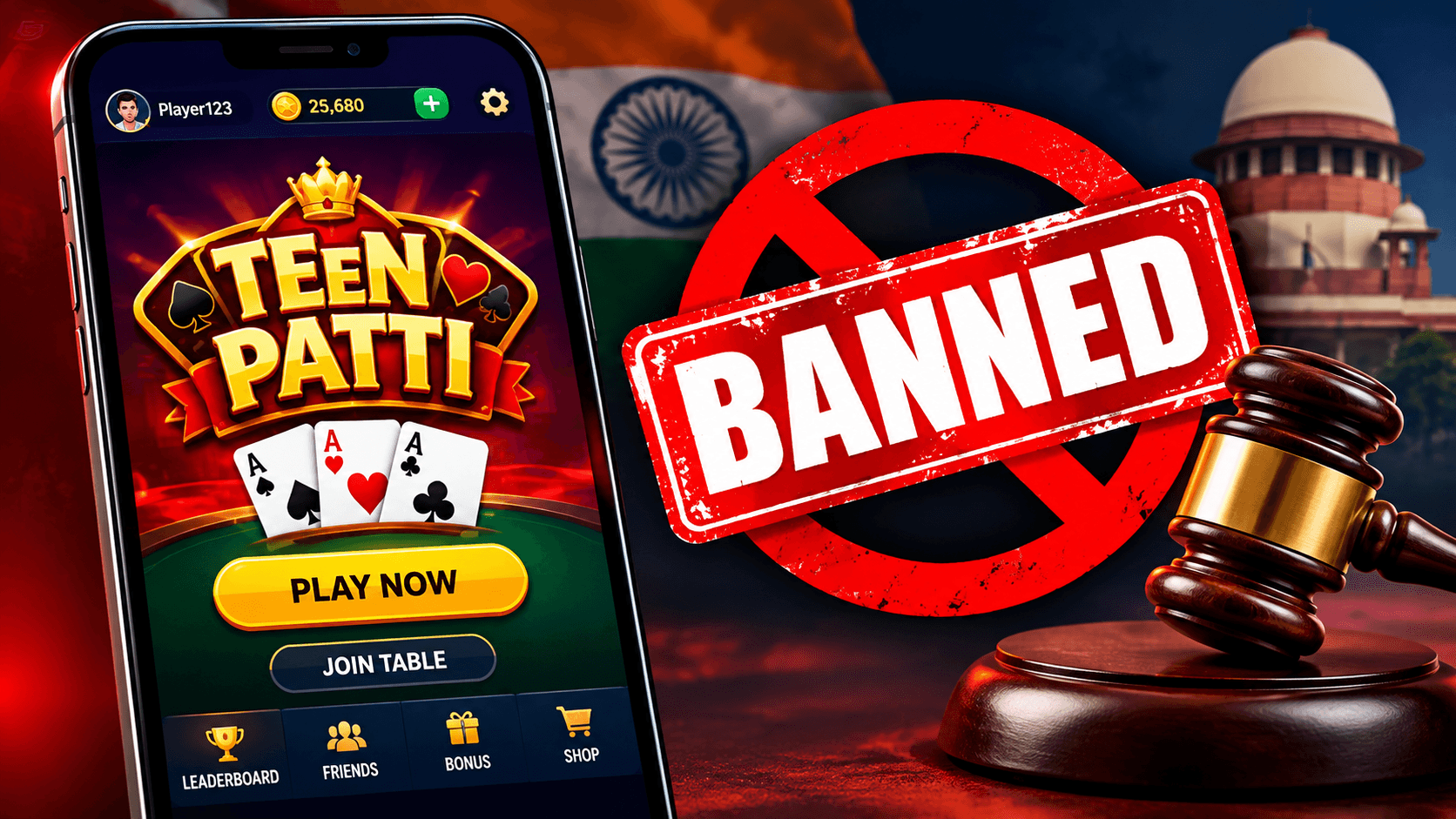
If you still have a Teen Patti apps on your phone with real money sitting in your account, you need to read this.
Since May 1, 2026, every online real-money game in India is illegal. Not just in a handful of states — across the entire country. The Promotion and Regulation of Online Gaming Act, 2025, which Parliament passed and the President signed into law, imposes a blanket ban on all online games played for monetary stakes. Teen Patti, rummy, poker, fantasy sports, colour-prediction games — all of them.
The old skill-versus-chance debate that gaming companies hid behind for years? The new law sidesteps it entirely. It does not matter whether the game requires skill. If real money goes in and real money comes out, it is now a criminal offence to offer it, advertise it, facilitate payments for it, or — in the strictest reading — play it.
Here is what the law actually says, what it means for the estimated 100 million Indians who played these games, and what you should do right now if you have money trapped in an app that is technically no longer allowed to operate.
What Changed on May 1, 2026
For years, India’s online gaming industry operated in a patchwork of grey areas. The century-old Public Gambling Act of 1867 said nothing about the internet. Individual states like Telangana, Andhra Pradesh, Assam, and Odisha had passed their own bans on real-money gaming, but most of the country remained effectively unregulated. Gaming companies argued their products were games of skill, protected by Supreme Court precedent, and pointed to high court rulings in Rajasthan and Bombay that appeared to agree.
That era ended when Parliament passed the Promotion and Regulation of Online Gaming Act, 2025. The accompanying rules, notified by the Ministry of Electronics and Information Technology on April 30, 2026, took effect the next day.
The law creates a single, national framework that replaces the old state-by-state confusion. At its centre is a new regulator — the Online Gaming Authority of India (OGAI) — established under Section 8 of the Act. OGAI’s job is to oversee what remains of the legal gaming sector: e-sports and social games without monetary stakes.
Everything else — every game where you put money in hoping to get money out — is now banned by a central Act of Parliament. As Electronics and IT Secretary S. Krishnan put it when the rules were announced, the law is unambiguous: online money gaming is banned and cannot be registered or recognised under the Act.
What Exactly Is Banned Now
The law defines an “online money game” as any online game played with the payment of money or other stakes, with an expectation of winning money or gaining other enrichment. Under that definition, all of the following are now illegal to offer in India:
- Teen Patti for real money — whether on Teen Patti Master, Teen Patti Gold, Teen Patti Star, or any other app that accepts deposits and pays out winnings
- Online rummy for real money — including platforms like RummyCircle and Junglee Rummy that previously operated under skill-game protections
- Online poker for cash stakes — PokerBaazi, Adda52, and similar platforms
- Fantasy sports with entry fees — Dream11, My11Circle, and others that charged entry fees with cash prize pools
- Colour-prediction and crash games — apps that functioned as thinly disguised gambling
- Any other online game where real money goes in and real money comes out
The critical point is that the Act bans the entire category. It does not distinguish between skill and chance. A game can require deep strategic thinking, and it is still banned if it involves monetary stakes played online. The skill-versus-chance framework that gaming companies relied on for a decade has been legislated out of existence.
Free-to-play versions of these games — where you play Teen Patti with virtual chips that cannot be withdrawn as real money — remain legal. The ban targets money, not the games themselves.
What Is Still Legal
The Act does not ban all gaming. It carves out clear exceptions:
- Free social games — Playing Teen Patti, rummy, or any card game with virtual chips that hold no real-money value is completely legal. You can play with friends on an app as long as no money changes hands.
- Recognised e-sports — Competitive gaming in titles like BGMI, Valorant, or FIFA, where players compete for prizes or merchandise without wagering, is now formally recognised and regulated under the Act. E-sports platforms must register with OGAI.
- Licensed offline casinos — Physical casinos in Goa, Daman, and Sikkim continue to operate under their existing state licences. The new law governs online play specifically.
- State-authorised lotteries — Government-run lotteries in states like Kerala, Goa, and Maharashtra remain legal as they operate under separate legislation.
The dividing line is simple: if you pay money online hoping to win money, it is banned. Everything else — playing for fun, competing in e-sports, or visiting a licensed physical casino — is not.
The Penalties Are Severe
This is not a soft regulatory nudge. The Act prescribes criminal penalties:
- Operating or offering an online money game can attract imprisonment of up to five years and substantial fines.
- Facilitating payments for such games — including banks and payment apps that process deposits — can face enforcement action, with penalties of up to three years’ imprisonment or fines up to ₹1 crore.
- Advertising or promoting real-money gaming platforms is a separate criminal offence. This extends to social media influencers and YouTubers who promote Teen Patti apps with referral codes — a practice that was rampant before the ban.
- Non-compliant websites and apps can be ordered blocked under Section 14 of the Act, using the same blocking machinery as the Information Technology Act, 2000.
The law is primarily aimed at operators, not individual players. But the text is broad enough that legal experts warn users should not assume they are beyond its reach, particularly if they are depositing money into platforms they know are operating illegally.
Why Teen Patti Apps Still Show Up on Your Phone
If you search “Teen Patti” on the Google Play Store or Apple App Store right now, you will still find dozens of apps. Some still advertise real-money play. This confuses people into thinking the ban is not real or does not apply to them.
It applies. Here is why the apps persist:
Many of these platforms run their servers from outside India — from Malta, Curaçao, the Philippines, or other jurisdictions with gambling licences that have no authority in India. They distribute APK files through their own websites, Telegram groups, and YouTube promotions rather than official app stores. A foreign gambling licence does not override Indian law. An app being available for download does not mean it is legal to use.
Some apps have pivoted to free-to-play models, removing real-money features to comply with the law while keeping their user base. Others have simply not complied yet, operating in defiance of the Act while government enforcement catches up.
The government has begun blocking non-compliant platforms, and the Enforcement Directorate has flagged several operators for money laundering investigations. But enforcement across thousands of apps takes time, and new ones appear regularly.
The bottom line: if an app still accepts your real-money deposit for online gaming in India, that app is operating illegally. Play Store availability is not legal approval.
What Happens to Money Already in Your Account
This is the question that keeps millions of players up at night. If you deposited money into Teen Patti Master, Teen Patti Gold, or any similar app before or after May 1, 2026, your situation depends on whether the app is cooperating with the shutdown or not.
Apps that are winding down their real-money operations should allow you to withdraw your remaining balance. If an app is refusing withdrawals, delaying payouts, or has gone completely silent, you are likely dealing with a platform that was already operating on the margins of legality — and now has little incentive to return your funds.
Here is what you can do:
- Attempt withdrawal immediately. If the app still has a functioning withdrawal process, use it. Do not leave money sitting in an app whose legal status is in question.
- Document everything. Screenshot your balance, transaction history, deposit receipts, and any communication with the app’s support team.
- File a consumer complaint. The National Consumer Helpline (1800-11-4000) and the INGRAM portal (consumerhelpline.gov.in) accept complaints about digital platforms. Include your screenshots.
- Report to the cyber crime portal. If the app has disappeared with your money, file a complaint at cybercrime.gov.in.
- Do not deposit more money. No matter how confident you are that you can “win it back,” adding funds to an illegally operating platform puts you at greater risk — both financially and legally.
The hard truth is that money deposited into unregulated platforms was always at risk. The ban makes that risk official.
The Bigger Picture: Why India Did This
India’s online real-money gaming industry had grown into a market projected to exceed $5 billion. Tens of millions of young Indians — many of them students, daily-wage workers, and first-time smartphone users — were depositing money into apps that promised easy earnings. The social cost was becoming impossible to ignore.
Reports of gambling addiction among young people had reached crisis levels. Families reported sons and daughters draining savings, borrowing from loan apps, and in the most tragic cases, taking their own lives after losing money on gaming platforms. The manipulative design of many apps — constant notifications, bonus lures, loss-chasing mechanics — drew comparisons to predatory lending.
The government’s stated objectives in passing the Act were to protect minors and vulnerable users, curb addiction, prevent financial fraud and money laundering through gaming platforms, and establish clear rules for the sector.
Industry leaders warned that the ban would push players to offshore, unregulated platforms — exactly the outcome regulators wanted to prevent. The projected damage to the industry is estimated at over $840 million in write-downs, with significant job cuts across gaming companies.
Whether the ban ultimately achieves its goals or drives the problem underground remains to be seen. What is clear right now is that the legal ground beneath every real-money gaming app in India has disappeared, and players who continue to deposit money into these platforms are doing so at their own risk, with no legal protection if things go wrong.
Sources
- India Bans Real-Money Online Gaming, New Rules From May 1 — BW Businessworld
- India’s Online Gaming Act Takes Effect May 1, 2026 — India Briefing
- Promotion and Regulation of Online Gaming Act, 2025 — Wikipedia
- Online Gaming Law in India 2026: PROGA FAQs — LL.B Mania
- India Bans Real-Money Online Games, Regulates E-sports — WhalesBook
- India Online Gaming Rules 2026 Explained — TalkEsport
- Which Money Game Is Legal in India? (2026) — Right to Information Wiki
- New Online Gaming Rules 2026 Explained — SolvLegal
