Teen Patti Master Guide – Beginner Tips, Rules & Gameplay
New to Teen Patti Master and want to understand how the game works? This Teen Patti Master Guide covers the basics beginners need before playing, including Teen Patti rules, card rankings, gameplay, common terms, beginner tips, and mistakes to avoid.
Teen Patti is a traditional three-card game that is commonly played with a standard deck of cards. Different digital versions can offer different tables, modes, rules, features, or settings, so always check the rules displayed inside the particular game mode you are using.
Teen Patti Master Guide: Quick Answer
Teen Patti is generally played with three cards dealt to each player. Players compare their hands according to the applicable hand-ranking system, with common rankings including Trail (three of a kind), Pure Sequence, Sequence, Color, Pair, and High Card. The exact rules, betting structure, and available modes can vary between versions.
For beginners, the best way to learn Teen Patti gameplay is to understand the hand rankings first, then learn the table actions and practice reading the game before making decisions.
Table of Contents
What Is Teen Patti Master?
Teen Patti Master refers to a digital Teen Patti gaming experience designed around the traditional three-card format. Depending on the particular version or platform, players may find different tables, game modes, interface options, social features, or additional card-game variations.
The core concept is easier to understand than the interface may initially suggest. Players receive three cards and try to make the strongest qualifying hand according to the rules being used at the table.
If you are completely new to the game, focus on learning the basic hand rankings and table terminology before worrying about advanced decisions.
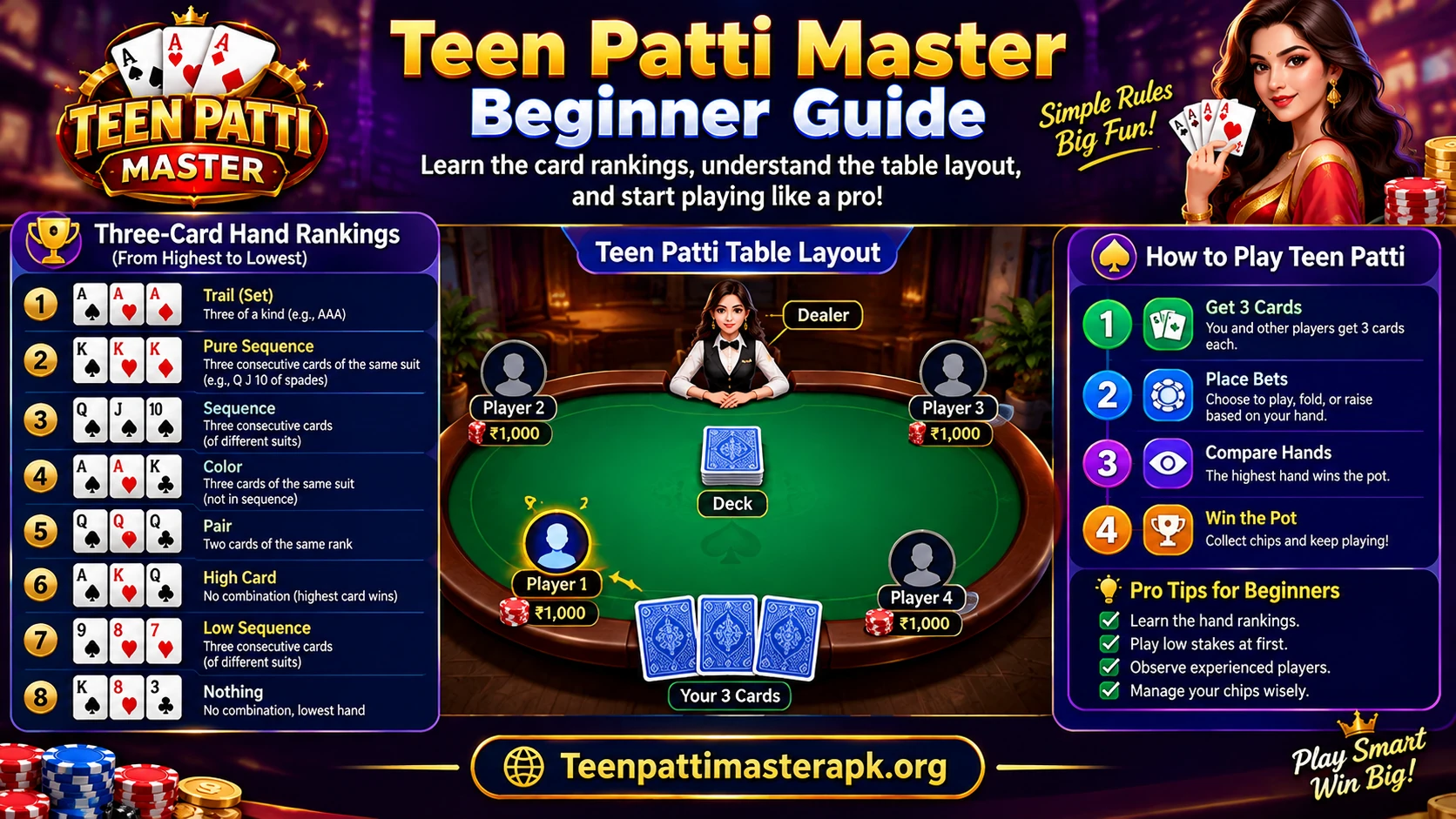
How Teen Patti Gameplay Works
Traditional Teen Patti is usually played with three cards per player. A dealer distributes cards face down, and players then make decisions according to the betting and table rules.
The exact sequence can differ between digital versions, but the general flow is easy to follow.
- Players join a table or game.
- A starting stake or ante may be established according to the table rules.
- Each player receives three cards.
- Players take turns making the available table decisions.
- Players may continue, fold, or use other actions provided by the specific mode.
- The remaining hand or hands are compared when the round reaches its conclusion.
- The winner is determined according to the applicable hand-ranking rules.
Because digital Teen Patti games can introduce variations, beginners should always read the rules shown for the selected mode rather than assuming every table works exactly like another version.
Basic Teen Patti Rules for Beginners
Learning the basic rules is the first step toward understanding Teen Patti Master gameplay. The traditional game uses three cards for each player and a standard ranking system.
Three Cards Per Player
Each player normally receives three cards. In the traditional version, the cards are dealt face down, which means players generally do not see another player’s hand unless the rules of the particular variation allow it.
Hand Strength Matters
Your three cards form your hand. The hand-ranking system determines how your cards compare with another player’s cards.
Players Take Turns
Players act in turn according to the table structure. Depending on the version, available actions can include playing as a blind player, playing seen, calling, raising, folding, or requesting a show.
The Round Ends According to the Table Rules
A round can end when all but one player has folded or when the applicable showdown or show condition is reached. The exact process depends on the game variation.
Different Variations Can Have Different Rules
This point is important for beginners. Teen Patti has many variations, and a digital platform may include additional modes with their own rules. Always check the instructions displayed before entering an unfamiliar mode.
Teen Patti Card Rankings
Understanding the card hierarchy is one of the most important parts of any Teen Patti beginner guide. The following rankings are commonly used in traditional Teen Patti.
| Rank | Hand | Example | Meaning |
|---|---|---|---|
| 1 | Trail / Three of a Kind | A-A-A | Three cards of the same rank. |
| 2 | Pure Sequence | 4-5-6 of the same suit | Three consecutive cards of the same suit. |
| 3 | Sequence | 4-5-6 | Three consecutive cards, not necessarily of the same suit. |
| 4 | Color | K-8-3 of the same suit | Three cards of the same suit that are not a sequence. |
| 5 | Pair | Q-Q-7 | Two cards with the same rank. |
| 6 | High Card | A-J-8 | No higher-ranking combination is formed. |
Some Teen Patti variations may use different ranking details or special rules. If the digital table provides its own ranking information, follow that version’s rules.
Trail
A Trail, also called three of a kind, contains three cards of the same rank. For example, three Kings form a Trail.
Pure Sequence
A Pure Sequence consists of three consecutive cards belonging to the same suit. It is stronger than an ordinary Sequence in the commonly used ranking system.
Sequence
A Sequence consists of three consecutive cards. The cards do not have to share the same suit.
Color
A Color contains three cards of the same suit without forming a sequence.
Pair
A Pair contains two cards with the same rank, while the third card has a different rank.
High Card
If a hand does not form one of the higher combinations, it is generally compared as a High Card hand.
Common Teen Patti Terms Beginners Should Know
Learning the vocabulary makes the table easier to understand. Some terms can also vary by platform or regional rules.
- Blind
- A player who makes decisions without looking at their cards in versions that support blind play.
- Seen
- A player who has looked at their cards.
- Chaal
- A common term for a player’s stake or call during a betting round.
- Raise
- Increasing the amount being played according to the table’s permitted betting rules.
- Fold
- Leaving the current round instead of continuing to play.
- Show
- A comparison of hands when the rules and table conditions permit it.
- Pot
- The accumulated amount being contested during a round.
Not every digital Teen Patti mode uses every term. Check the table instructions when a feature is unfamiliar.
Teen Patti Beginner Tips
Good beginner advice starts with understanding the game rather than trying to memorize complicated tactics. These tips can help new players read the table more clearly.
1. Learn the Hand Rankings First
Before focusing on betting decisions, memorize the basic order of Trail, Pure Sequence, Sequence, Color, Pair, and High Card. Knowing your hand’s category makes every later decision easier.
2. Understand the Table Rules
Do not assume that every Teen Patti table follows identical rules. Read the instructions for the mode you select, especially when trying a new variation.
3. Start Slowly
Beginners often try to understand every feature at once. A better learning process is to start with the basic table, learn the controls, and then explore additional modes.
4. Watch the Game Before Making Decisions
Pay attention to the order of play and the actions available at the table. Understanding the interface can be just as important as understanding the cards.
5. Avoid Chasing Losses
If a round does not go your way, increasing your next stake simply to recover the previous result can lead to poor decisions. Set a limit before playing and respect it.
6. Do Not Confuse Luck With Skill
Card distribution contains an element of chance. No strategy can guarantee a particular result from an individual hand.
7. Learn From the Rules, Not From Random Claims
Online guides can disagree about specific Teen Patti variations. When a rule differs between sources, use the rules provided by the game mode you are actually playing.
Understanding Teen Patti Gameplay Decisions
Once the basic rules are clear, beginners can start thinking about decisions in a structured way. The goal is not to predict every outcome. Instead, understand the information available and make decisions within the rules and limits you have set.
Consider Your Hand
The first piece of information is your own three-card hand. Identify whether you have a Trail, Sequence, Color, Pair, or High Card.
Consider the Table Situation
Look at the current round, the number of active players, and the actions available. The same hand can feel different in different table situations.
Understand That Opponent Actions Are Not Proof
A player’s action does not reveal their cards with certainty. Avoid treating a call, raise, or fold as guaranteed evidence of a particular hand.
Set Limits Before Playing
If the version you are playing involves real-money stakes, decide your budget and time limit before starting. Never increase spending simply because you want to recover a previous loss.
Teen Patti Master Game Modes
Digital Teen Patti platforms can offer multiple game modes. The names and rules can change between versions, so beginners should read the instructions for each mode before playing.
Some platforms may also include additional card games or entertainment modes alongside traditional Teen Patti. These modes should not be assumed to follow the standard Teen Patti ranking system.
If you are building a complete Teen Patti Master resource on your website, separate guides for individual modes can make the information easier to understand. A main guide can explain the basics, while dedicated pages can cover the rules and gameplay of each specific mode.
Common Beginner Mistakes in Teen Patti
Not Learning the Rankings
Trying to play before learning the hand hierarchy creates unnecessary confusion. Learn the six common hand categories first.
Ignoring Table Rules
A variation can change the way a round works. Always read the rules displayed by the selected game mode.
Playing Every Hand
Beginners sometimes continue every round simply because they have been dealt cards. Your cards and the table situation should influence whether you continue.
Increasing Stakes Emotionally
Trying to recover a loss immediately can lead to larger and less controlled decisions. Keep your limits separate from the result of a single round.
Assuming a Strategy Guarantees Wins
No legitimate strategy can guarantee a winning result in a game involving random card distribution. Be cautious of claims promising guaranteed wins, fixed outcomes, or secret methods.
Responsible Teen Patti Gameplay
Teen Patti can involve different types of play depending on the platform and jurisdiction. Where real-money play is involved, users should understand the applicable local laws, age requirements, platform rules, and financial risks before participating.
Never play with money you cannot afford to lose. Set spending and time limits, avoid chasing losses, and take a break if playing stops feeling enjoyable or controlled.
For younger users, free or non-monetary learning modes may be more appropriate where available. Always follow the applicable age restrictions and local requirements.
Frequently Asked Questions
What is Teen Patti?
Teen Patti is a traditional three-card card game. Players receive three cards and compare their hands according to the applicable ranking and table rules.
How many cards does each player get in Teen Patti?
In traditional Teen Patti, each player receives three cards.
What is the strongest hand in Teen Patti?
In the commonly used traditional ranking system, a Trail or three of a kind is the highest-ranking hand.
What comes after Trail in Teen Patti?
A Pure Sequence generally follows Trail in the traditional hand-ranking order.
What is a Pure Sequence in Teen Patti?
A Pure Sequence consists of three consecutive cards of the same suit.
What is a Sequence in Teen Patti?
A Sequence consists of three consecutive cards. Unlike a Pure Sequence, the cards do not necessarily have to belong to the same suit.
What is a Color in Teen Patti?
A Color normally consists of three cards from the same suit that do not form a sequence.
What is a Pair in Teen Patti?
A Pair contains two cards with the same rank and one different card.
What is the best Teen Patti strategy for beginners?
There is no strategy that guarantees a particular result. Beginners should first learn the hand rankings, understand the table rules, observe gameplay, and set clear limits.
Is Teen Patti based entirely on skill?
No. Card distribution introduces chance. Player decisions can affect how they approach a round, but no strategy can control which cards are dealt.
Are Teen Patti rules the same everywhere?
No. Different variations and digital platforms can use different rules, betting structures, or special features. Check the rules for the specific mode you are playing.
Can beginners learn Teen Patti quickly?
The basic rules are relatively simple to learn. Start with hand rankings and table actions before exploring more advanced variations.
Final Thoughts
This Teen Patti Master Guide gives beginners the foundation they need to understand the game: three-card gameplay, traditional hand rankings, common table terms, basic decisions, and responsible play.
The easiest way to improve your understanding is to learn the hand rankings first, read the rules of the selected mode, and become familiar with the table interface. Avoid claims about guaranteed wins or secret strategies, because card distribution involves chance.
Once the fundamentals are clear, you can explore specific Teen Patti variations and gameplay guides in more detail. Keeping each topic focused makes it easier to learn the game and find the information you need.
